

Choosing the right aluminum grade is essential for manufacturers who need reliable formability, corrosion resistance, and consistent material performance. Among commercially pure aluminum grades, 1100 aluminum and 1050 aluminum are widely used in applications such as sheet metal fabrication, chemical equipment, electrical components, and industrial products. Although these two grades share many properties, differences in chemical composition, purity, and applicable standards can influence their suitability for specific projects.
So, what is the difference between 1100 and 1050 aluminum? The main distinctions lie in their minimum aluminum content, impurity limits, and standard specifications. Understanding these differences helps buyers, engineers, and manufacturers select the right aluminum material for their production requirements.
In this guide, Shaanxi Shunchengtian explains how 1100 and 1050 aluminum compare in composition, mechanical properties, corrosion resistance, workability, and industrial applications.
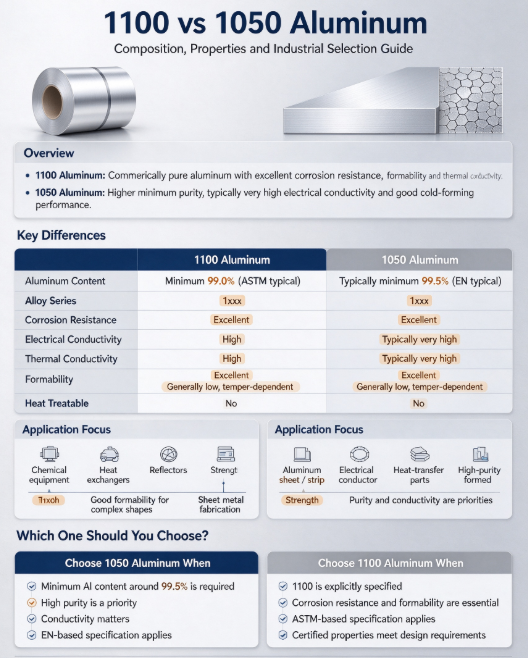
1. What Is 1100 Aluminum?
1100 aluminum is a commercially pure aluminum alloy known for its excellent corrosion resistance, high thermal and electrical conductivity, and outstanding formability. It belongs to the 1xxx series of aluminum alloys and contains a minimum of 99.0% aluminum under the commonly used ASTM alloy designation.
The remaining composition consists primarily of small amounts of iron, silicon, copper, and other trace elements. These elements influence the material's mechanical behavior and processing characteristics without significantly changing its overall nature as a commercially pure aluminum grade.
One of the key advantages of 1100 aluminum is its ability to undergo bending, drawing, and spinning operations. It is particularly suitable for products that require complex shapes without the strength levels associated with heat-treatable aluminum alloys.
Common applications include chemical processing equipment, heat exchangers, reflectors, cooking utensils, decorative components, and sheet metal products. Its good conductivity also makes it useful in selected electrical and thermal applications.
However, 1100 aluminum is relatively soft compared with many alloyed aluminum grades. It is generally selected for applications where corrosion resistance, conductivity, and fabrication performance are more important than high structural strength.
2. What Is 1050 Aluminum?
1050 aluminum is another commercially pure aluminum grade in the 1xxx series. It typically contains a minimum of 99.5% aluminum under commonly used EN and related European material specifications, although the exact requirements depend on the applicable standard.
Its relatively high aluminum content gives 1050 aluminum excellent corrosion resistance, high electrical conductivity, and good thermal conductivity. It also offers excellent cold-forming performance, making it suitable for rolling, bending, stamping, and other manufacturing processes.
1050 aluminum is frequently used to manufacture aluminum sheets, strips, plates, reflectors, chemical equipment, heat-transfer components, and electrical conductor-related products. It is also available in different tempers, allowing manufacturers to select material with appropriate strength and formability characteristics.
Because 1050 aluminum has a higher specified minimum aluminum content than 1100 aluminum, it is often considered when material purity and conductivity are important selection criteria. Nevertheless, higher purity alone does not guarantee better performance in every application. The final properties also depend on temper, thickness, processing history, and product specifications.
For buyers evaluating 1050 aluminum sheet or plate, checking the material certificate and applicable standard is essential to ensure that the supplied product meets the intended requirements.
3. 1100 vs. 1050 Aluminum: Key Differences
The most important distinction between these grades is their chemical composition specification. Both are commercially pure aluminum materials, but they are not interchangeable designations.
| Comparison | 1100 Aluminum | 1050 Aluminum |
|---|---|---|
| Aluminum content | Minimum 99.0% under common ASTM specifications | Typically minimum 99.5% under common EN specifications |
| Alloy series | 1xxx | 1xxx |
| Corrosion resistance | Excellent | Excellent |
| Electrical conductivity | High | Typically very high |
| Thermal conductivity | High | Typically very high |
| Formability | Excellent | Excellent |
| Strength | Generally low; depends on temper | Generally low; depends on temper |
| Heat treatment | Not strengthened by conventional precipitation hardening | Not strengthened by conventional precipitation hardening |
| Typical applications | Heat exchangers, cookware, reflectors, chemical equipment | Aluminum sheets, reflectors, electrical applications, heat-transfer products |
Important: These aluminum-content figures refer to commonly used specifications, not every possible regional or product standard. Mechanical properties and conductivity should be verified against the exact alloy standard, product form, thickness, and temper.
4. Chemical Composition: Why Does Aluminum Purity Matter?
Chemical composition is the foundation of the difference between 1100 and 1050 aluminum. The 1050 designation generally requires a higher minimum aluminum content, while 1100 permits a broader composition within its specified limits.
The controlled presence of elements such as iron, silicon, and copper can influence conductivity, strength, surface appearance, and processing behavior. However, it is not accurate to assume that every 1050 aluminum product will outperform every 1100 aluminum product in all these areas.
For example, electrical conductivity can be affected by impurity levels and manufacturing conditions. Similarly, surface finish depends on rolling quality, annealing, and subsequent treatment, rather than alloy designation alone.
When purchasing aluminum materials for industrial production, buyers should review the applicable chemical composition table and request a material test certificate when necessary. This is particularly important for projects involving electrical conductivity requirements, chemical exposure, or tightly controlled manufacturing processes.
Shaanxi Shunchengtian recommends evaluating the complete material specification instead of relying only on the alloy number when comparing commercially pure aluminum products.
5. Mechanical Properties: Which Grade Is Stronger?
Neither 1100 nor 1050 aluminum is primarily designed for high-strength structural applications. Both are valued for their purity, corrosion resistance, and ability to be formed into different shapes.
Their mechanical properties depend heavily on temper. Annealed material, commonly designated O temper, is generally softer and more formable. Strain-hardened tempers, such as H14 or H18 where applicable, offer increased strength but reduced ductility.
As a result, comparing 1100-O with 1050-H18 would not provide a fair assessment of the difference between the two alloys. A meaningful comparison requires matching the temper, thickness, product form, and test standard.
For manufacturers producing deep-drawn parts, bent panels, or complex sheet metal components, ductility and forming performance may be more important than a small difference in tensile strength. For applications involving vibration, loading, or structural support, a higher-strength aluminum alloy may be more appropriate.
Before placing an order, engineers should confirm tensile strength, yield strength, elongation, and other required properties against the relevant material specification.
6. Corrosion Resistance and Electrical Conductivity
Both 1100 and 1050 aluminum offer excellent resistance to atmospheric corrosion because aluminum naturally develops a thin protective oxide film on its surface.
This makes them suitable for many indoor and outdoor products, as well as equipment exposed to a range of industrial environments. However, performance still depends on exposure conditions. Strong acids, strong alkalis, chloride-rich environments, and galvanic contact with dissimilar metals may require additional evaluation.
Electrical conductivity is another important consideration. Both grades are conductive, but 1050 aluminum's higher specified purity can make it attractive for applications where conductivity is a priority. Actual performance should be verified using the relevant specification and test data.
For electrical applications, engineers should compare conductivity requirements, operating temperature, connection design, and mechanical loading before choosing a grade. For chemical equipment, compatibility with the process medium should take priority over aluminum purity alone.
7. Common Applications of 1100 and 1050 Aluminum
Although these grades share many characteristics, their typical uses can differ according to industry requirements and purchasing specifications.
1100 aluminum applications include:
Chemical processing tanks and selected equipment components
Heat exchangers and thermal transfer products
Reflectors, decorative parts, and lighting components
Cooking utensils and formed aluminum products
General-purpose sheet metal fabrication
1050 aluminum applications include:
Aluminum sheets and strips for industrial fabrication
Electrical conductor-related components where the specification permits
Reflectors and products requiring a suitable surface finish
Heat-transfer components and thermal applications
Formed products requiring high-purity commercial aluminum
These examples are not exclusive. Either grade may be suitable for similar products when the relevant chemical, mechanical, and manufacturing requirements are satisfied.
The best choice depends on the final product design, applicable standards, fabrication process, and performance criteria.
8. How to Choose Between 1100 and 1050 Aluminum
Selecting between 1100 and 1050 aluminum starts with identifying the most important requirements of the finished product.
Choose 1050 aluminum when:
A specification calls for a minimum aluminum content of approximately 99.5%.
High purity is a priority.
Electrical or thermal conductivity requirements need to be evaluated using the applicable grade specification.
The material must comply with a particular EN or other recognized standard.
Choose 1100 aluminum when:
The engineering specification explicitly permits or requires 1100 alloy.
Excellent corrosion resistance and formability are essential.
The material's conductivity and mechanical properties meet the application requirements.
The project uses an established ASTM-based material specification.
In either case, buyers should confirm the alloy designation, temper, thickness tolerance, surface quality, dimensions, and delivery requirements. These details can be just as important as the alloy number itself.
Working with a qualified aluminum supplier also helps reduce the risk of purchasing material that does not match the intended standard or fabrication process.
9. Frequently Asked Questions
Is 1050 aluminum better than 1100 aluminum?
Not necessarily. 1050 aluminum typically has a higher specified minimum aluminum content, which may be beneficial for applications requiring high purity. However, 1100 aluminum can be equally suitable or preferable when it meets the project's specified mechanical, electrical, and processing requirements.
Is 1100 aluminum stronger than 1050 aluminum?
There is no universal strength ranking that applies to every product. Strength depends on temper, thickness, processing history, and the applicable material standard. Compare certified mechanical properties for equivalent product conditions before making a selection.
Can 1100 and 1050 aluminum be used for the same applications?
Yes. Both grades are used in applications requiring corrosion resistance, conductivity, and good formability. However, they should only be substituted for each other when the engineering specification, customer requirements, and applicable standards permit the substitution.
Which grade is better for aluminum sheet metal fabrication?
Both grades offer excellent formability. The best option depends on the required purity, temper, thickness, forming method, and final performance. For demanding forming operations, the specified temper and elongation values should be checked carefully.
Are 1050 and 1100 aluminum heat-treatable?
Neither grade is strengthened through conventional precipitation-hardening heat treatment. Their strength is mainly controlled through cold working and temper selection. Annealing can be used to restore ductility after strain hardening.
Conclusion: Making the Right Aluminum Grade Selection
The primary difference between 1100 and 1050 aluminum is their specified chemical composition, particularly the minimum aluminum content. Both grades provide excellent corrosion resistance, good conductivity, and outstanding formability, but the right choice depends on the requirements of the finished product rather than purity alone.
For industrial buyers, checking the material standard, temper, mechanical properties, and certification is the most reliable way to determine whether 1100 or 1050 aluminum is suitable.
Shaanxi Shunchengtian supports informed aluminum material selection by helping customers evaluate product specifications and application requirements. Whether your project requires 1100 aluminum or 1050 aluminum, confirming the correct grade and material standard before production can help improve manufacturing consistency and reduce unnecessary material costs.


