3003 aluminum is one of the most widely used aluminum alloys for general manufacturing. It combines moderate strength, good corrosion resistance, and excellent formability, making it suitable for products that need to be bent, drawn, stamped, or shaped during production.
Unlike pure aluminum grades, 3003 contains manganese as its main alloying element. This addition improves its strength while maintaining good workability. As a result, manufacturers often choose 3003 for cookware, heat exchangers, roofing materials, storage tanks, and other fabricated components.
However, choosing the right aluminum alloy requires more than understanding its basic properties. Buyers also need to consider the forming process, required temper, product dimensions, and working environment. This guide explains what 3003 aluminum is, where it performs best, and what to check before purchasing it.

1. What Is 3003 Aluminum Made Of?
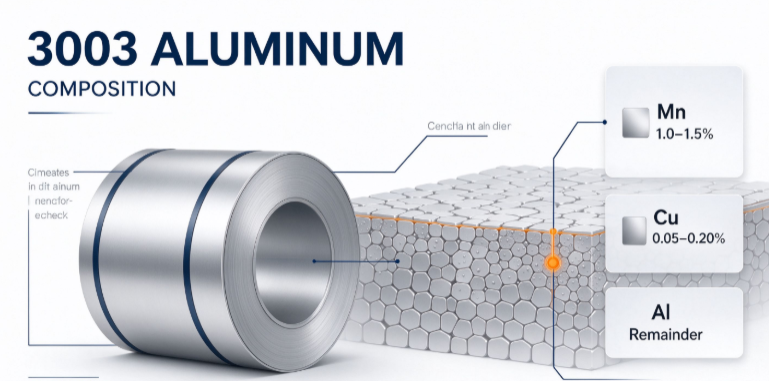
3003 aluminum belongs to the 3xxx series of wrought aluminum alloys. Its main alloying element is manganese, which generally accounts for 1.0% to 1.5% of its composition. It also contains a small amount of copper, typically 0.05% to 0.20%, while aluminum makes up the remainder.
The addition of manganese gives 3003 higher strength than commercially pure 1100 aluminum without sacrificing too much formability. This makes it a practical choice for applications that require more strength than pure aluminum but do not need the high strength of structural alloys.
Typical chemical composition limits include:
| Element | Composition |
|---|---|
| Aluminum (Al) | Remainder |
| Manganese (Mn) | 1.0–1.5% |
| Copper (Cu) | 0.05–0.20% |
| Silicon (Si) | 0.60% max |
| Iron (Fe) | 0.70% max |
| Zinc (Zn) | 0.10% max |
Actual composition should be verified against the applicable material standard and the mill test certificate supplied with the order.
2. What Makes 3003 Aluminum Different from Pure Aluminum?
The main reason manufacturers choose 3003 is its balance between strength and workability.
Compared with commercially pure aluminum, 3003 offers higher strength while retaining useful forming characteristics. It can be bent, drawn, spun, and fabricated into many shapes without requiring the more demanding processing conditions associated with some high-strength alloys.
Its main advantages include:
Moderate Strength: Manganese improves the strength of the alloy, making it more suitable than many commercially pure aluminum grades for general sheet metal products.
Good Formability: 3003 can be used in bending, drawing, spinning, and stamping applications. This is especially useful for manufacturers producing containers, cookware, and formed metal components.
Corrosion Resistance: It performs well in many normal atmospheric and moisture-exposed environments. This makes it suitable for building materials and general industrial equipment. However, aggressive chemicals and marine exposure require a more specific material evaluation.
Good Weldability: 3003 can be joined using suitable welding processes and procedures. The final joint performance depends on the welding method, filler material, and design.
Thermal Conductivity: Its ability to transfer heat makes it useful in cookware and certain heat-transfer components.
These properties make 3003 a versatile manufacturing material. It is not designed for every application, though. When a component requires high structural strength or specialized corrosion resistance, another alloy may be more appropriate.
3. Where Is 3003 Aluminum Commonly Used?
The combination of formability, moderate strength, and corrosion resistance gives 3003 a wide range of practical applications.
Cookware and Kitchen Equipment
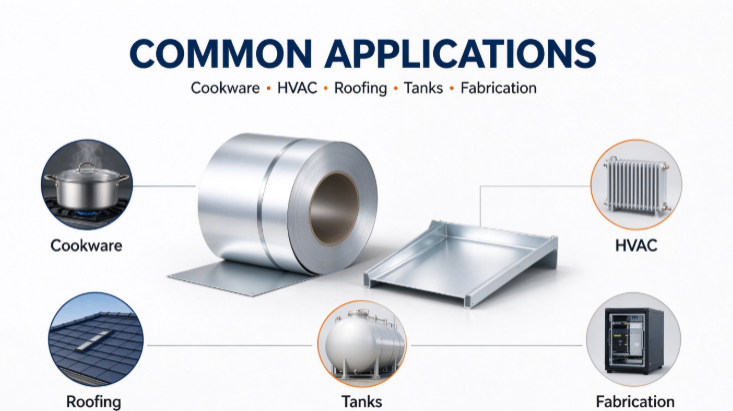
3003 aluminum is commonly used for pots, pans, kitchen containers, and other household products. Its formability supports drawing and spinning processes, allowing manufacturers to produce shaped components efficiently. Its thermal conductivity is also useful in cookware applications.
HVAC and Heat Exchanger Components
Manufacturers use 3003 in air conditioning components, heat exchanger parts, and related sheet metal products. Its thermal properties and forming performance make it suitable for components that need to be shaped into specific profiles.
Roofing and Building Materials
3003 can be processed into roofing panels, gutters, siding, insulation panels, and architectural components. Its relatively low weight and corrosion resistance are useful in building applications, although the surface finish and protection system should be selected according to the installation environment.
Storage Tanks and Industrial Equipment
The alloy is used in certain tanks, containers, and chemical-handling equipment where moderate strength and suitable corrosion resistance are sufficient. The chemical environment must be checked before selecting the material, particularly when the equipment will handle aggressive substances.
General Sheet Metal Fabrication
3003 is also used for enclosures, panels, covers, ducts, and other formed metal parts. Its workability helps manufacturers produce components with different shapes and dimensions.
The key is to match the alloy to the actual manufacturing process. A component that requires deep drawing may need a different temper from one that only requires simple bending.
4. Is 3003 Aluminum Heat Treatable? Understanding Its Tempers
One important feature of 3003 aluminum is that it is a non-heat-treatable alloy. Unlike 6061, its strength cannot be increased through conventional solution heat treatment and artificial aging.
Instead, its mechanical properties are adjusted mainly through cold working and annealing. This is reflected in its temper designation.
Common tempers include:
3003-O: Fully annealed condition. It offers high ductility and is suitable for forming operations that require significant deformation.
3003-H12: Strain-hardened condition with a relatively moderate strength level.
3003-H14: A commonly used half-hard temper that provides a balance between strength and formability.
3003-H16: A harder condition than H14, offering higher strength but reduced ductility.
3003-H18: A fully strain-hardened condition with higher strength and lower formability.
3003-H24: Strain-hardened and partially annealed, providing a useful combination of strength and workability.
For example, a manufacturer producing deeply drawn cookware may prefer a softer condition, while a company making panels or formed building components may consider a harder temper.
The correct choice depends on the required forming depth, bend radius, finished strength, and applicable standard. Buyers should confirm the temper rather than ordering 3003 aluminum based on the alloy number alone.
5. How Does 3003 Aluminum Compare with 1100 and 5052?
Although these three alloys are used in industrial manufacturing, they serve different purposes.
| Comparison | 1100 Aluminum | 3003 Aluminum | 5052 Aluminum |
|---|---|---|---|
| Main alloying element | Commercially pure aluminum | Manganese | Magnesium |
| Strength | Relatively low | Moderate | Higher |
| Formability | Very good | Very good | Good, depending on temper |
| Corrosion resistance | Good | Good | Very good, including many marine environments |
| Typical applications | Electrical parts, reflectors, general fabrication | Cookware, HVAC, roofing, formed components | Marine parts, vehicle panels, equipment enclosures |
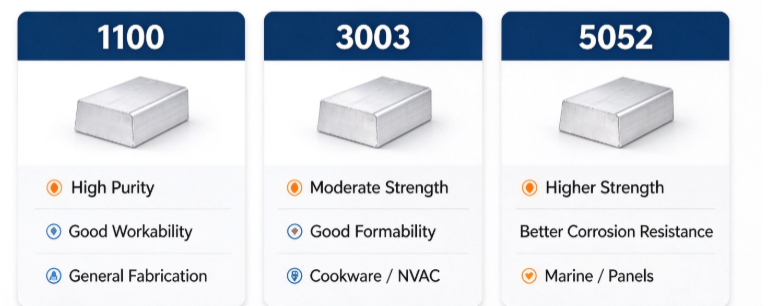
Choose 1100 when high aluminum purity, conductivity, and workability are priorities. Choose 3003 when you need a practical balance of formability, corrosion resistance, and moderate strength. Consider 5052 when the application requires higher strength or improved performance in demanding environments.
For buyers, the best option is not necessarily the alloy with the highest strength. A stronger material may increase costs or require changes to the forming process. The right grade should meet the product's actual requirements without adding unnecessary material expense.
6. What Should You Check Before Ordering 3003 Aluminum?
A material specification that looks correct on paper may still cause problems if it does not match the production equipment or final product design.
Before placing an order, confirm these details:
Product form: Specify whether you need 3003 aluminum coil, sheet, or plate.
Thickness and dimensions: Provide the required thickness, width, and length, together with dimensional tolerances.
Temper: Confirm whether O, H14, H18, H24, or another condition is suitable for your process.
Material standard: Identify the required ASTM, EN, or other applicable standard.
Surface condition: Clarify whether a mill finish, protective film, or other surface requirement is needed.
Quantity and packaging: State the order quantity and any special export packaging requirements.
Quality documents: Confirm whether an MTC or third-party inspection is required.
If the material will be deep drawn, welded, bent, or used in a heat exchanger, explain the intended process to the supplier. This information helps reduce the risk of receiving material that meets the nominal grade but performs poorly during production.
7. Source 3003 Aluminum from SCT for Your Manufacturing Requirements
For industrial buyers, sourcing 3003 aluminum is not just about finding the lowest price per ton. The material must match the required specifications, and the supplier needs to support clear communication, quality verification, and international delivery.
Shaanxi Shunchengtian Material Co., Ltd. (SCT) is an integrated industrial and trading enterprise supplying stainless steel, carbon steel, aluminum products, and related materials. Its multi-category product range gives buyers a practical option for coordinating different metal material requirements through one supplier.
SCT operates a 40,000-square-meter facility and reports a total monthly output of 30,000 tons across its product categories. Its production resources include pickling, galvanizing, and color-coating lines, as well as processing capabilities for steel plates, pipes, and strips. This is the company's overall output, not a dedicated 3003 aluminum production capacity.
For aluminum sourcing, SCT offers multiple grades, including 1050, 1060, 1100, and 3003. Buyers can discuss the required alloy, temper, dimensions, quantity, and material documentation before confirming an order. This is particularly useful when a project involves comparing different aluminum grades or coordinating several metal product categories.
SCT implements a quality inspection system and reports certifications, including ISO 9001, BV, SGS, and CE-related certifications. Specific material documents and inspection arrangements can be discussed according to each order's requirements.
With more than 20 years of export experience since 2003, SCT serves customers in Europe, Southeast Asia, Africa, North America, and South America. Its established freight-forwarding partners and shipping arrangements through major ports such as Qingdao, Tianjin, and Shanghai provide practical support for overseas deliveries.
Whether you need 3003 aluminum for cookware, HVAC components, roofing, or general fabrication, providing clear specifications and application details helps SCT evaluate your requirements and prepare a more relevant quotation.
Contact SCT with your required product form, temper, thickness, dimensions, and order quantity to discuss 3003 aluminum supply for your next project.